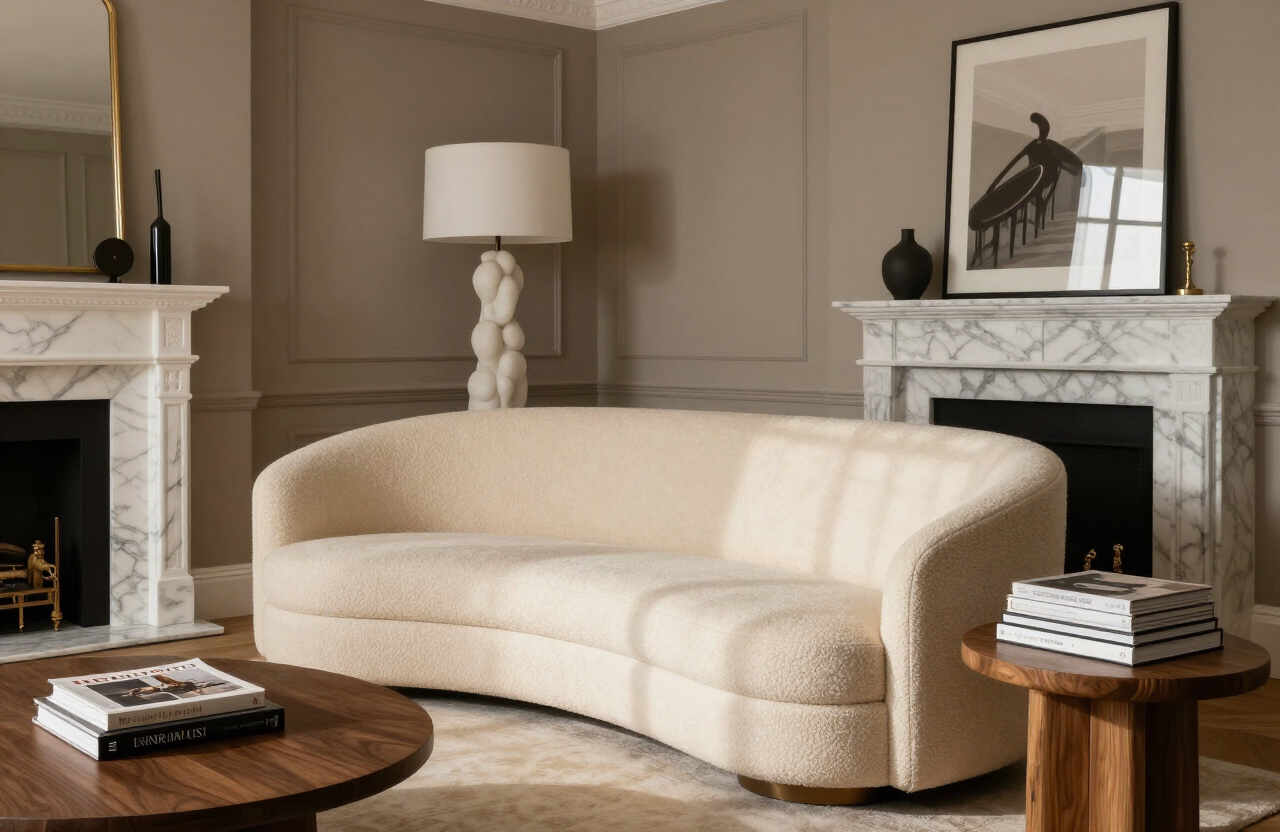
Every few years the design press declares the curved sofa over, and every year it refuses to leave. There is a reason: rooms are full of right angles — walls, windows, rugs, frames — and a single rounded silhouette relieves all of them. One curve can soften an entire floor plan.
Where curves work hardest
A curved sofa floating in the middle of a room — rather than pressed against a wall — creates circulation behind it and conversation in front of it. In smaller living rooms, a round coffee table performs the same trick at ankle height, letting traffic flow where corners would catch hips and shins.
The supporting cast matters. Pair one major curve with straighter companions: a rectilinear rug, a clean-lined media console, a square side table. Curves need contrast to read as intentional rather than themed.
Rooms are full of right angles. A single rounded silhouette relieves all of them.
Buying one that lasts
Look for tight upholstery in a fabric with some grip — bouclé, wool, or a heavy linen blend — because curves show sagging faster than straight seams. A kiln-dried hardwood frame and eight-way hand-tied springs are the unglamorous details that decide whether the piece is a classic or a costume.
If a full curved sofa feels like a commitment, start with a rounded armchair or an arched floor lamp. The principle scales down gracefully: one generous curve per room is usually enough.